
Katrina Granados said her husband was gone in the “blink of an eye.”
On the morning of May 6, 2025, Walter Granados, her spouse of over nine years, called her around 6:15 a.m. as he was heading to work. He had barely approached his car on the residential street of their Sun Valley neighborhood when he was apprehended by federal immigration enforcement agents outside their apartment.
“Me garan la migra.” ICE grabbed me, he told his wife when she answered the phone.
Katrina said she thought he was joking, but he assured her, “No es broma.” This is not a joke.
In a state of panic, Katrina rushed downstairs, where she recalls spotting two federal officers on her street. Her husband was nowhere to be seen.
She told Courier California that she jumped in her car and drove around the block to see if she could find her husband. When she had no luck, she contacted Walter’s boss to assist. After hours of searching, however, Katrina was left with more questions than answers.
“I’m not sure why he was targeted…all I know is that my husband has never been to jail, he never had a criminal background—all he did was take care of his family and pay taxes.”
The two met in 2016. Katrina said Walter used to work security at a Salvadoran restaurant she frequented in Hawthorn, California, called ‘La Bamba.’ They quickly became acquainted, then later started dating. She said they got married in May 2017, after which Walter became the stepfather to her two oldest children and became a central pillar of the family. Katrina and Walter went on to have three biological children of their own in the years following.
After Walter was abducted, Karina said she “hit rock bottom.” She spent weeks trying to track him down and hire legal counsel—all while managing her daily duties as a mother of five children.
Walter was eventually transferred to Adelanto ICE Processing Center in San Bernardino County, where he spent the next eight months. He spoke to Courier California about his time there, saying it was an experience so horrible that he would not wish it upon anyone.
Walter described the conditions at the facility as inhumane and said that the staff at Adelanto often restricted access to food and water for detainees—a potentially deadly punitive measure for a facility that is located in the high desert.
“La verdad a mi me dejo marcado todo eso que tuve que vivir.” The truth is everything I lived through has left a mark on me, he told Courier California.
As of May 2026, six people have died in California’s ICE detention centers in the past year, according to the California Department of Justice. Four of those deaths have occurred at Adelanto.
In January of 2026, Walter was deported to El Salvador, where he continues to live and work.
Since President Trump took office in January 2025, more than 9,000 Salvadorans have been deported from the US back to El Salvador. Salvadoran President Nayib Bukele has positioned himself as an ally to the Trump administration and even signed an agreement to imprison US deportees at the Salvadorian mega-prison, Centro de Confinamiento del Terrorismo, frequently referred to as CECOT.
Behind the deportation statistics are thousands of mixed-status families that are experiencing the real-life consequences of Trump’s mass deportation policies. California has an estimated 7,190 mixed-status households—families comprising US citizens and undocumented or ineligible immigrants, according to the US Department of Housing and Urban Development.
Katrina said she has not told her three youngest children about their father’s deportation.
“I really haven’t spoken to them about it,” she said, “I’ll just say papi is working…but they don’t know that papi has been deported.”
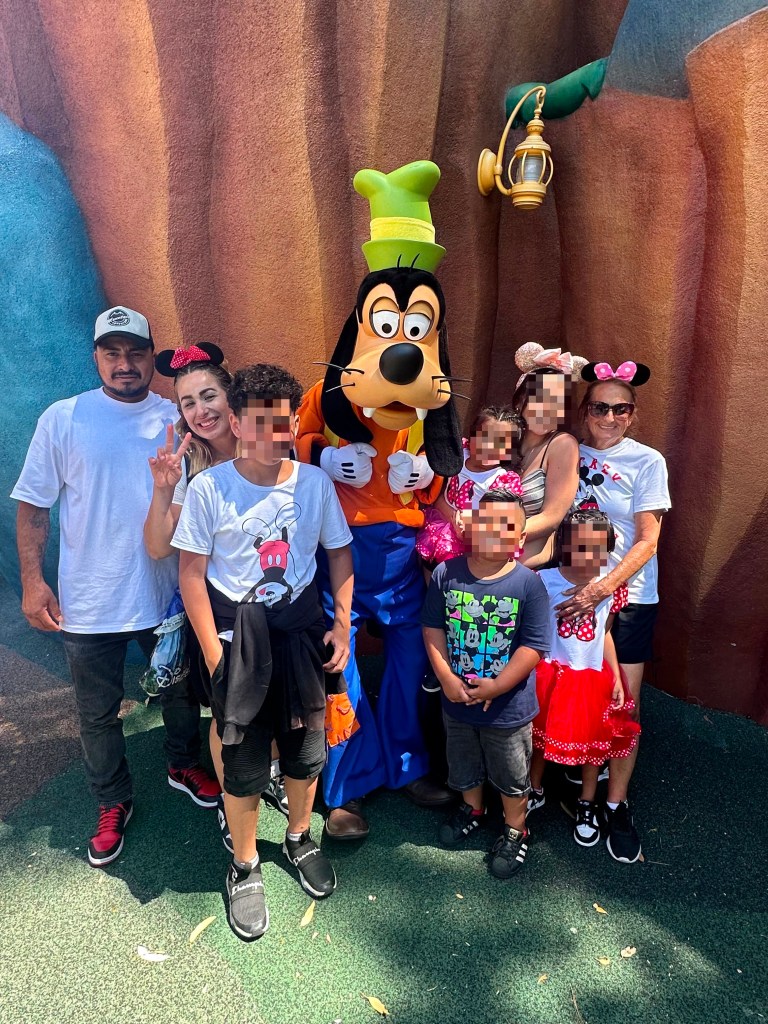
Over the last year, it has become increasingly difficult for Katrina to manage finances at home, without her husband. She has taken on odd jobs and catering gigs to sustain her household expenses.
Prior to Walter being deported, Katrina said their family had a very traditional structure, in which Walter was the primary source of income while she managed the children and the home.
“He was always there, he was always the backbone, he always provided for us.”
Community advocates and local mutual aid organizers have rallied around Katrina and her family. Hester Jean Lee, a social media influencer who does vendor buyouts through community fundraising efforts, recently started a fundraiser for Katrina and Walter. Lee aims to raise $25,000 to help the family reunite.
Hester said she was moved to action after meeting Katrina at a community event and learning more about her story.
“My mom was also a single mom,” Lee told Courier California, “she had a tough time with two children…I couldn’t even imagine five.”
The digital activist said it can feel like people are collectively experiencing a sense of helplessness right now, so she seeks to direct people to solutions.
“A lot of times we ask ourselves well what can I do about it. In Katrina’s case here is a chance to do something.”
Lee said that at the very least, she hopes that her following will help cover the expenses for a one-time trip to El Salvador for Katrina and her five kids, so they can see Walter.
According to the GoFundMe, proceeds will cover passports, airfare, lodging, and meals during the trip. The visit won’t solve the family’s situation in the long term, but it offers them a rare chance to reunite—even if briefly.
“I understand that I can’t help all families but I can at least amplify Katrina’s story,” Lee said.
Katrina said she also hopes the trip would present the opportunity for her to tell her youngest children about the reality of their father’s deportation.
“We wanted to wait to talk about it together.”
In the meantime, Katrina says she is trying her best to stay optimistic, but she admits the ordeal has taken a toll on her mental health.
“I feel like these days I’m drowning,” Katrina said. “I wish this were a dream…I never expected this to happen to my family.”