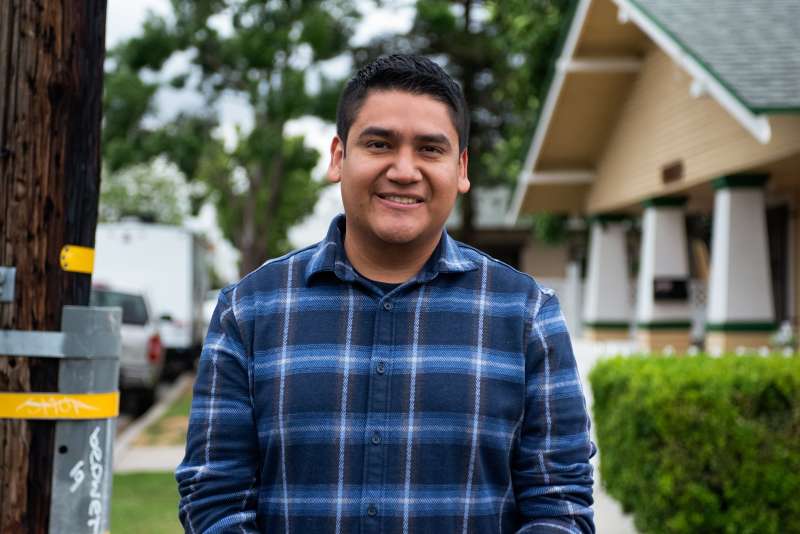
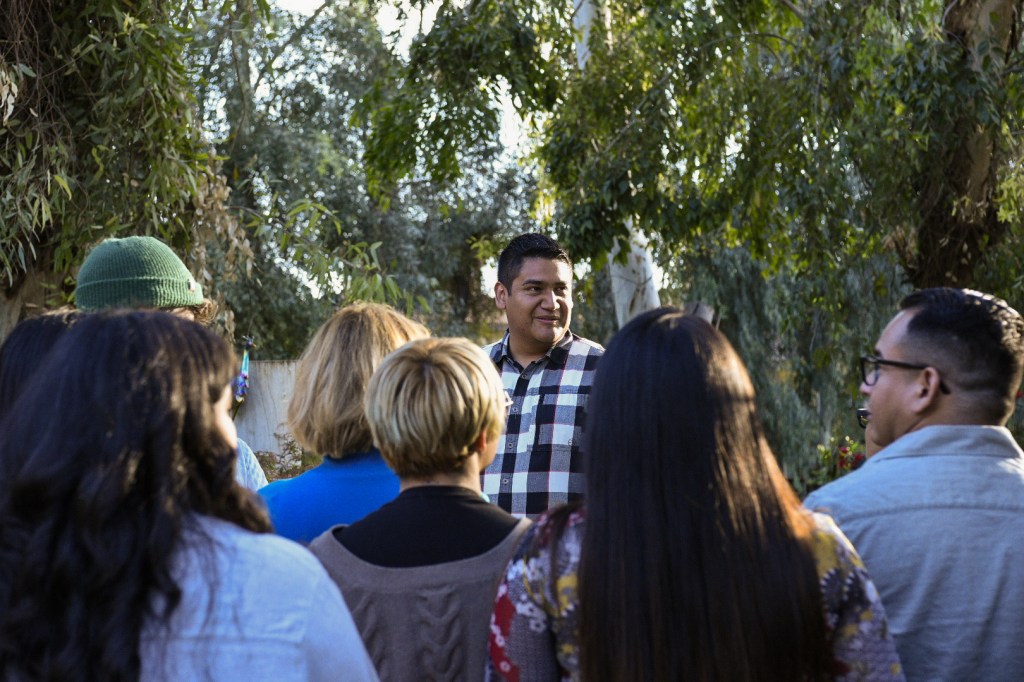
Randy Villegas is a political science professor and co-owner of his family’s auto repair shop. Now, he is looking to add “elected official” to his resume.
The 31-year-old is the Democratic nominee looking to unseat Rep. David Valadao (R-Hanford) in California’s 22nd Congressional District. The region is predominantly agricultural, and its economy relies heavily on farmworkers.
With the passage of Proposition 50, Valadao now faces a redrawn district that narrowly favors Democrats. Villegas defeated an establishment-backed, moderate Democrat in the primary and hopes to flip the district, which is considered a toss-up.
In an interview, Villegas told Courier California he is running for Congress because of his deep love for the Central Valley. He said he aims to represent the farmworkers who “get up at the crack of dawn to feed not only Bakersfield, but the entire country.”
Villegas is the son of Mexican immigrants—his father is from Michoacán and his mother from Guerrero—and he grew up in Bakersfield. Although his family was working class, Villegas was fortunate enough to be the first in his family to attend university, and later he earned a full-ride fellowship for his PhD.
“I am running for Congress because the programs that helped me get to where I am today—such as Medicaid and free or reduced breakfast and lunch programs, as well as WIC—are being gutted by this administration to provide more tax breaks for billionaires,” Villegas said.
Villegas has built his campaign around economic populism, corporate PAC-free fundraising, and protections for the Central Valley’s farmworkers and agricultural economy. But the race is being watched well beyond the district: as one of the country’s most competitive seats, CA-22 could help determine control of the House.
Courier California’s political correspondent spoke with the political hopeful.
This interview has been edited for brevity and clarity.
Q: Given the district’s challenges for Democrats, why do you think this seat is winnable in November?
Numbers-wise, this should have been a Democratic seat a decade ago—strong Democratic majority, strong Latino majority—yet we have a Republican in office. We need a campaign that actually talks about solutions to the issues people are facing.
I think if there’s one lesson learned from Democrats more broadly in 2024. It’s that we can’t just offer people not Trump or not Valadao. We have to offer people a vision for something to believe in. And to me, that means fighting for things like universal healthcare, universal childcare, and making sure that we have an economy that actually is focused on working families as opposed to billionaires. And I think the contrast between myself and my Republican opponent here couldn’t be stronger.
My mom always taught me growing up many dichos, many sayings of wisdom, and the one that stuck with me on this campaign trail is “Dime con quien andas y te dire quien eres.” Tell me who you’re with, and I’ll tell you who you are. And the same thing can be said about politics. Tell me who you’re taking money from, and I’ll tell you who you’re taking orders from, you know, and that’s why I’m proud to be the only candidate in this race that’s 100% corporate-free. Never taken a corporate “back check,” and I never will because I want to be accountable to our communities and not corporate interests.
And meanwhile, my Republican opponent is funded by Amazon, Walmart, Chevron, Exxon Mobil, United Health—a corporation using AI algorithms to deny elderly people’s claims so that they can continue to profit while our family members suffer, and to that we say no more. Congressman Valadao was the deciding vote on this “big bullshit bill,” which is going to gut Medicaid in a district where we have the [highest share of] Medicaid recipients in the entire country, and it’s because he’s working for the health insurance companies; he’s working for Big Pharma. He’s working for his corporate sponsors, and not on behalf of our communities.
Q: What are the key distinctions between you and Congressman David Valadao?
It’s in who we’re actually working for and who we’re actually fighting for, and I think H.R.1 [The One Big Beautiful Bill Act] is a perfect example of this. He signed on to several letters saying he wasn’t going to vote for this bill if it affected Medicaid in any way.
Two out of every three of our constituents rely on Medicaid, and the moment he got the opportunity to vote on it, he voted in favor of H.R. 1. He lied to us. He betrayed our communities, and he doesn’t even have the courage to show up and explain to people why he voted the way that he did. He voted to cut $880 billion of Medicaid and WIC and all these other programs to give 1.1 trillion dollars in tax cuts to the wealthiest people in this country because that’s who he actually works for.
When I get to Congress, I actually want to fight for legislation that’s going to make the first $70,000 of income taxes tax-free for every American across this country. And how are we going to do that? By making sure billionaires and centimillionaires in this country pay their fair share. I’m focused on giving working families a break, not billionaires and corporations like Valadao is.
And you know, when it comes to healthcare, that’s why one of my top priorities is not only going to be to reverse this big bullshit bill, but to actually fight for healthcare as a human right. Because let’s talk about where we are right now as a country, where two out of every three bankruptcies are tied to medical debt, where every year over 66,000 Americans die because they don’t have health insurance or because they’re underinsured. Not because we couldn’t treat them, not because we couldn’t save them, but because of a system that denied them care.
And that’s why, in Congress, I will be a day-one co-sponsor of Medicare for All, because healthcare is a human right, and nobody should have to choose between rationing their insulin and paying for their groceries. Nobody should have to choose between paying their mortgage and seeing a doctor. And I’m here to say that nobody should have to fight cancer and their congressmen at the same time.
Q: Do you think Democrats are failing to meet the demands of working-class Californians on affordability?
I think we need to meet the moment. People are frustrated with the status quo and with broken promises on things like immigration reform and affordability. We need Democrats who will fight, not fold, against this administration. I think we need to use every tool possible to ensure that we’re actually fighting to deliver results for our working families, and that we’re not going back to whatever the status quo was, but actually fighting for a future to believe in
Take childcare, for example — the pushback is always, “How do we pay for it?” We should ask that same question about the roughly billion dollars a day we’re spending on a war in Iran nobody asked for. New Mexico has universal childcare, Vermont figured it out, New York is moving that direction. It’s not a question of resources—it’s whether we have representatives who have the political courage and the moral clarity to actually fight for these things, which is what I’m going to do every single day in Congress.
Q: What federal protections would you champion for farmworkers and campesinas, especially given ongoing immigration enforcement concerns?
Kern County and the Central Valley were ground zero for this administration’s ICE raids early in 2025. I immediately got to work organizing Know Your Rights workshops, brought together in 16 pro bono immigration attorneys, and turnout was huge. There’s real fear among people just driving to work, school, or the grocery store… that they may be separated from their families. I want to make sure that we actually champion policies to have a path to citizenship for folks and for our neighbors in our country who not only feed the rest of the country but the rest of the world.
I support the Farmworker Modernization Act, which provides a pathway to citizenship for agricultural workers. We also need better working conditions—it’s regularly 105-107 degrees here, so we need enforced heat protections, water breaks, and cooling spaces. I credit Senator Padilla’s Asunción Valdivia Act, named after a farmworker who died on the job, and want to see it passed.
People don’t realize that all these policies passed roughly 100 years ago to allow people to unionize, organize, and have things like minimum wage and guaranteed overtime after working 40 hours a week specifically excluded agricultural workers. And so it’s time that we right the wrongs of history and fight for the deal that farmworkers deserve.
Q: You’ve refused PAC money and taken a hard line on corporate influence, especially regarding oil, utility, and PG&E interests in your district. Why was that stance important to you?
I’m a small business owner myself, and I want to cut red tape for small businesses—but I won’t fight for big corporations getting tax breaks and buying influence through PAC checks. It’s blatant corruption, and Valadao is the perfect example. The same politicians who take money from PG&E and SoCal Edison tell us they can’t do anything to lower utility bills.
It’s the same politicians who take money from health insurance companies and big pharma that want to convince us that we should be happy paying twice as much for healthcare and paying the most for prescription drugs across this country. Because again, “Dime con quién andas, y te diré quién eres.” Tell me who you’re with, and I’ll tell you who you are. The same thing can be said about politics, and these politicians are not working for our working families. They’re working for their corporate sponsors and their billionaire buddies who help them get elected. And what we are seeing right now in the Central Valley is a clear message we sent in the primary: we overcame over $4 million in outside spending to send a clear message that the Central Valley, unlike David Valadao, is not for sale.
Q: Any final message for California’s 22nd District voters before they head to the polls?
To the people of the Central Valley and anybody who’s watching at home, I would tell them that if you are fed up with the status quo in Washington, D.C., with somebody who’s failed to show up for our communities and who doesn’t even have the respect to have a face-to-face town hall with our communities? Then I would love to be your representative in Congress to truly fight for the people of the Central Valley who’ve been left behind by politicians in both parties who continue to sell us out to corporations, to foreign interests, and to their billionaire buddies.
I am here to fight for the people of the Central Valley, deliver results for the people of the Valley, and make sure we have somebody in Congress who’s actually going to fight for us, because our lives depend on it. Because here in the Valley and across the country, they do.