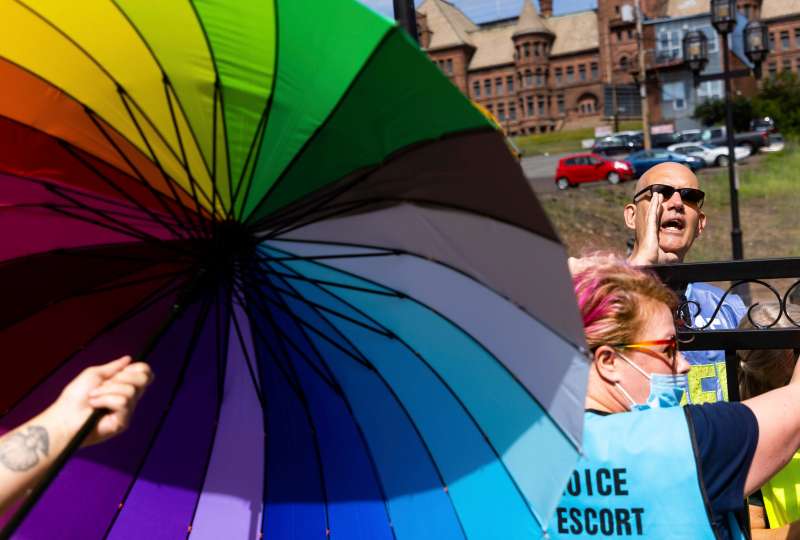
Sarah has been a volunteer abortion clinic escort for the past four years at one of the California Planned Parenthood clinics. Here, she shares with Courier California Special Correspondent Bonnie Fuller the very personal reason she is so committed to the work.
I got pregnant when I was 17, and I was so stereotypical. It was the night of my senior ball, right before I graduated from high school. I believed, erroneously, that the “withdrawal” method would work.
My period was very regular at the time, so when I missed it, I went immediately to my local Planned Parenthood clinic, where I took a pregnancy test and found out that I was, in fact, pregnant.
I had steeled myself for this news. I remember sitting in a chair, and when the Planned Parenthood medical provider was asking me what I would like to do, I immediately told her that I wanted an abortion. I didn’t hesitate, and I had the procedure a week or two later.
Luckily, my boyfriend supported my decision, and he helped me pay for the abortion.
The clinic staff didn’t hesitate about asking me which method of birth control I would like to start after the abortion, in order to prevent another unplanned pregnancy. Back then, the birth control pill was the most obvious option, so I told the medical provider that I would like a prescription for the pill.
I wished someone had suggested that I go on the pill before I had sex, but Planned Parenthood got me started.
‘I knew my parents wouldn’t support my decision’
I was raised in a very Catholic family, but my parents were newly divorced, so my life was turbulent at the time that I got pregnant. My parents had never really gotten along, and I had to switch between their houses every week. There wasn’t a lot of stability.
My mother had gotten pregnant when she was 19, and so she married my dad. They had my brother, and then I came along five years later. But despite what happened to my mother, the only birth control advice I was given by my mom was, “Don’t end up like me.”
Sadly, when my mom found out that I was sexually active, she just got angry with me—but never told me that I needed to protect myself, and ironically, I got pregnant a month later.
I didn’t tell either of my parents at the time because my mother had once told me that she could have had an abortion when she became pregnant with my brother at 19, but she chose not to. I knew that neither of my parents would support my decision.
Fortunately, I also knew about Planned Parenthood. I have never regretted my decision. I knew that I wanted to get an education and that I didn’t want to be like my parents and get married just because I accidentally got pregnant.
I can’t imagine having to marry that guy when I was 17 or 18. We became such different people with different belief systems.
I can’t imagine getting divorced from him and having to have co-parented a child with him. I also couldn’t see myself giving up a baby for adoption when I was 17, so the abortion was the best scenario for the situation I was in.
‘The protesters have no idea what their situation is’
It was because Planned Parenthood was there for me when I needed it that I always wanted to give back to the organization when I could.
After Donald Trump was first elected in 2016 and made it very clear that he wanted to restrict access to abortion, I became an ambassador for Planned Parenthood, where I would represent the organization at health fairs.
In 2022, when the clinics reopened after COVID-19, I signed up to become a volunteer abortion clinic escort, which had always been my goal. I wanted to help people like I had been helped.
Now I do this work two or three times a month for a few hours each time, and it’s been one of the very best things in my life, besides meeting my husband and having kids.
I had seen escorts when I was driving by other abortion clinics in California, and I always thought that I was so lucky not to have had to deal with protesters at the clinic where I went for my own abortion.
But while there weren’t protesters there, I still had people, like teachers in high school, telling me that abortion was bad. In fact, I was told this while sitting in a classroom the day before I went to get my abortion.
I can’t imagine what it would have felt like having to physically confront protesters on top of everything else when I was so young.
My heart goes out today when young girls come into our clinic, and many of them are in a very fragile state. They can’t help but hear the protesters—mostly men—shouting at them and telling them that they are “bad.”
As an escort, I want to protect them and let them know that their choice is their choice and that they need to do what is best for their lives, and that they aren’t a bad person because they might be doing something different from what someone else is telling them to do or expecting them to do.
The protesters have no idea what their situation is. So I try to shield these young girls.
But teenagers aren’t the only ones who can get very upset when they are yelled at by the protesters outside our clinic. The protesters will shout at patients: “Don’t kill your baby today,” or, “You’re going in there a mother, and you’ll still come out a mother, but your baby will be dead.”
They really try to play on a person’s guilt. Or this one protester will yell at patients, telling them that 90% of women who get abortions suffer from PTSD afterward. That’s absolutely not true, but it’s not my job to correct the lies. My goal is to protect patients from erroneous information by getting them away from the people lying and sending them inside to speak with the medical professionals in our clinic, who can answer their questions with facts.
Editor’s note: Research has concluded that the vast majority of women who have abortions do not experience PTSD. On the contrary: Women who are denied abortions and forced to carry unwanted pregnancies to term are more likely to suffer from mental health issues.
I remember one woman who was really upset by the cruelty of the wall of protesters that she had to walk through. She was crying and saying, “I’m not a bad person, I don’t know why they are doing this.”
I reassured her that she was in a safe place and that the protesters were not medical professionals, and that they had no idea why she was at our clinic.
We have a regular group of five or six protesters who are there. They are mostly men, though there are a couple of women, including one who is the wife of a regular male protester, and she shows up with her four children.
We were trained by Planned Parenthood not to interact with them at all. It just provokes them, and it’s not going to end well. We walk straight past them. We’re never going to change their minds about abortion.
I used to put earbuds in and listen to music while standing outside the clinic, and one day I was listening and singing along to Taylor Swift’s “Shake It Off,” and all the protesters hate Taylor Swift because she is a feminist.
One of the protesters who had a microphone started saying, “Yeah, they’re in there (the clinic) shaking off babies’ legs and shaking off babies’ arms.” So I’ve learned not to give them any more fuel for their fire by singing out loud.
Editor’s note: There are different abortion procedures, none of which involve the actions suggested by the protester in the story. The most common methods are abortion medication, which blocks the hormone needed to support a pregnancy and causes cramping and bleeding that empty the uterus, and an abortion procedure, which removes pregnancy tissue from the uterus.
‘I don’t like men standing there telling women what to do with their lives and their bodies’
Most of the volunteer escorts at our clinic are women, though we do have a couple of men. The other volunteers are just awesome, and we’ve become great friends. However, the protesters call us “witches” and say that we are “evil” and “satanic.”
I think I’ve always had a thing about people picking on other people who are vulnerable because I’ve often been the vulnerable person. I wanted to be able to stand up for people who may be in the most vulnerable time in their lives and to protect them from bullies.
I especially don’t like men standing there telling women what to do with their lives and their bodies. We don’t legislate men needing vasectomies or having to wear condoms.
People don’t yell at other people who are going to get colonoscopies or mammograms. This is healthcare, and you have a right to it without harassment and intimidation.
We keep at least 8 feet away from the protesters, and they are supposed to stay on the sidewalk, not enter our parking lot, and keep at least 8 feet away from anyone trying to enter the clinic. But many of them try to push those limits, and it’s gotten worse since Trump was reelected.
We do have a fence around the clinic, but there is one guy who brings a scaffold that’s 5 or 6 feet high, and he stands on it and stares at the entrance to the clinic.
He actually tries to get patients to come over and talk to him by offering them $20 just to have a conversation, and then he’ll try to convince them not to go into the clinic.
The biggest lie that the protesters tell patients is that they can get them the “abortion reversal” pill.
Editor’s note: There is no scientific study that has demonstrated a way to safely stop the two-pill medication abortion regimen. A 2019 study by the University of California-Davis had to be shut down when patients needed emergency hospitalization because of excessive vaginal bleeding.
I’m outside at the clinic in the pouring rain and cold weather. I feel fortunate that we haven’t been physically assaulted at our clinic, though that has happened at clinics elsewhere in the country.
I feel a great responsibility for getting people from their cars or the sidewalk into the clinic safely. While I am doing that, I want to respect their privacy. I never touch anyone unless they touch me first. I have had patients ask for hugs, and I’m willing to do that if we both feel comfortable.
As escorts, we can be that shoulder if a patient needs it. Patients don’t always have someone coming with them. But everybody deserves to have someone on their side when they’re at the clinic.
I’ve seen people crying in their cars before they get out, and I try to get close without hovering in order to be ready to help them when they are ready to get out. I don’t want them to be uncomfortable, since some people don’t actually want our help.
‘I hoped that my parents would understand’
After the Supreme Court overturned Roe v. Wade, I decided to email both my parents the next day and tell them about my pregnancy and abortion, because I had made my abortion experience public on social media in an attempt to help my friends commiserate on the impact of what had just happened.
I hoped that my parents would understand.
But my father never acknowledged my email, and my mother wrote that she believed that my abortion was the reason that I had a miscarriage when I first tried to start a family.
She told me that God took a baby away from me because I had taken a baby away from him. So I made a donation in her name to an abortion fund in Texas to help women in that state find abortion care outside of Texas.
She didn’t like that. My mother has had no relationship with me in years, and has only met my two oldest children a couple of times. I don’t see my father, either, but he sees my kids on holidays or whenever he wants to.
Fortunately, I have built a wonderful family with my husband and three children. I wouldn’t have this family if I had not had my abortion. While my parents, brother, and I don’t talk, I do have a great relationship with an aunt on each side of my family, so they are my surrogate parents.
Also, my mother-in-law treats me like her daughter.
My children, who are 22, 20, and 16, know about my abortion. I talk to them a lot about how important it is to have access to abortion and all reproductive healthcare.
I don’t want my kids to ever have to experience having to make the difficult choice that I had to. I tell them that if you aren’t going to plan on using birth control, then you have to plan to be pregnant because that’s what will happen. I warn them that they might not always have access to abortion like we are lucky to have in California right now.
My kids inspire me to do this work. I want them to have choices, and if they do get in the situation that I was in, I want someone to be there for them at a clinic, just like I am there for others. I don’t want my kids to ever feel like they have to put their lives in danger to make a choice that should be theirs—because it’s healthcare.