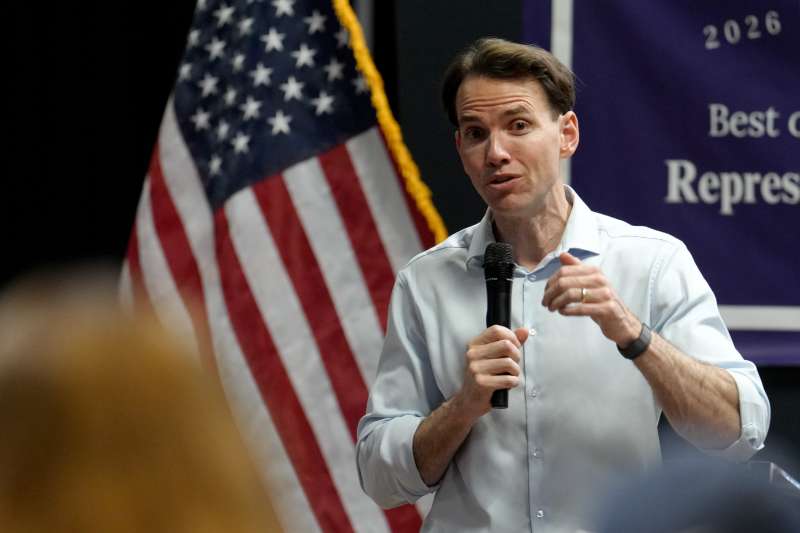
In March, US Rep. Kevin Kiley left the Republican Party and registered as “No Party Preference.” The former “MAGA champion” is now running in California’s newly drawn 6th Congressional District, a Democratic-leaning seat in the Sacramento area.
“This reflects the way I’ve always approached my role as an elected representative,” said Kiley during a hearing in March, “to hold politicians in both Sacramento and Washington accountable.”
Since his announcement, Kiley has broken with Trump on several issues, including Canada tariffs, and criticized the president’s ban on certain media outlets from the White House. He also said he does not plan to caucus with Republicans next year if he is reelected to the House as an independent.
However, Kiley was a registered Republican for most of his political career, and his record aligns with the Republican Party. In 2022, he was elected to Congress as a Trump-endorsed Republican, and the president hailed him as a “MAGA Champion.”
Kiley’s Democratic opponent, Dr. Richard Pan, says Kiley is trying to win Democratic voters after Prop 50 redrew his district, but that his MAGA-aligned history tells a truer story. Prop 50 was California’s direct response to Texas redrawing its congressional map mid-decade, which allowed it to boost Democratic chances in the U.S. House.
How did Kiley vote on Medi-Cal and safety net funding?
One example is Kiley’s vote supporting the Republican domestic policy megabill, known as the One Big Beautiful Bill Act, last summer. The bill passed 218-214, with only two Republicans voting against it. The Congressional Budget Office estimates it reduces federal Medicaid spending by nearly $1 trillion over the next decade, slashing Medi-Cal benefits for an estimated 3.4 million Californians.
The cuts Kiley voted for aren’t abstract. Sacramento County says up to 15,000 residents could lose health coverage under H.R. 1’s new federal rules. The county also estimates the law will add about $17 million in new costs this fiscal year and roughly $58 million next year. Local governments can’t easily absorb those costs.
When the Affordable Care Act expanded Medi-Cal, many Californians who had relied on county safety-net programs gained access to insurance. According to the Sacramento Observer, much of that old system of clinics, trained staff, and hospital partnerships was then dismantled or folded into Medi-Cal. Now, as H.R. 1 pushes people off coverage again, there’s far less to fall back on–and the safety net shrinks.
During the pandemic, Kiley opposed California’s COVID-19 school closures and vaccine mandates. As a state assemblymember, Kiley became one of Gov. Gavin Newsom’s chief antagonists during the pandemic. He contributed $10,984 to the recall from his campaign account, mostly in February 2021.
In August 2025, Kiley introduced H.R. 4889. The bill sought to ban mid-decade redistricting nationwide and void any maps states adopted after the November 2024 election.
Kiley’s seat was one of five Republican seats targeted under Prop 50. But he framed it as a way to stop a nationwide “redistricting war.” His opening statement targeted Newsom and left out Texas, where Republicans were redrawing maps at Trump’s urging.
Kiley urged House leadership to bring the bill to a vote, but the Republican leaders who needed to approve it offered no comment. As a result, the bill never reached the floor, and Proposition 50 passed, eliminating his district and diminishing his chances of reelection.
What is Kiley’s broader House record?
During the 43-day federal government shutdown, Kiley publicly backed the GOP position. The shutdown ran from Oct. 1 to Nov. 12, 2025–the longest in U.S. history. It began when Democrats refused to back a Republican funding bill that didn’t extend the expiring Affordable Care Act subsidies, while Republicans insisted on a “clean” bill and said health care should be negotiated separately.
He went on Fox News Radio and pushed back on what he called Schumer’s “manufactured crisis,” and criticized Democrats for refusing a clean continuing resolution.
Kiley may have abandoned the Republican label, but voters will still have questions about his record on the ballot. On Nov. 3, voters in the 6th District will decide whether “No Party Preference” is a change of heart or just a change of district.