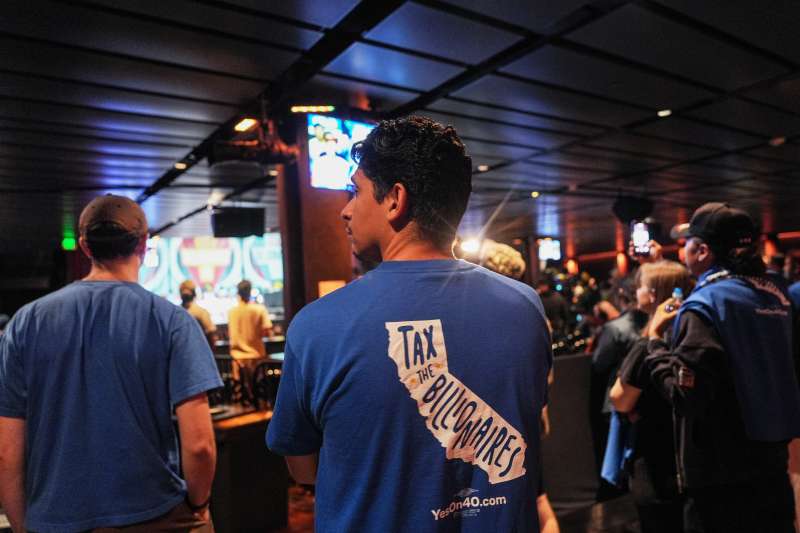
California voters were asked to tax the rich twice on Nov. 3, and they gave two very different answers. While voters comfortably passed Prop. 3 to make permanent an existing 12.3% income tax on top earners, they decisively rejected Prop. 40, an unprecedented proposal to impose the nation’s first-ever proposed tax on billionaires’ wealth.
Although early polls showed California voters supported the measure, it remained a divisive topic among registered Democrats throughout the midterm election.
Nearly 40 unions, including the Service Employees International Union-United Healthcare Workers West (SEIU-UHW), AFL-CIO, American Federation of Teachers (AFT), American Federation of Government Employees (AFGE), and UNITE HERE, backed the measure.
As of the morning of Nov. 4, roughly 56% of voters opposed Prop. 40 and approximately 44% supported it, according to the Associated Press.
The measure would have charged a one-time 5% tax on the net worth of the state’s roughly 200 billionaires, with proceeds going mainly to healthcare. Prop. 40 was also threatened by two billionaire-backed countermeasures on the ballot—Props. 41 and 42, which would ban wealth taxes—written so that if either passed with more yes votes than Prop. 40, the billionaire tax cannot take effect even if approved.
Prop. 40 backers outspent by billionaire-funded opposition
The proposal was one of the most expensive items on the ballot, as California’s wealthiest residents outspent supporters of the bill 250 to 1 to defeat the ‘billionaire tax.’
Billionaires and business groups spent hundreds of millions to defeat the measure, supporting two countermeasures in the process.
Google co-founder Sergey Brin raised more than $205 million against it as of mid-October, according to CalMatters. Voter support slipped from 52% in September to 46% in PPIC’s final poll.
Building a Better California, a prominent political action committee (PAC), played a leading role in opposing the measure. The ‘advocacy coalition’ was formed in January 2026. It includes high-profile tech executives, venture capitalists, and business leaders, such as Brin and former Google CEO Eric Schmidt.
But Prop. 40 was opposed not only by wealthy investors and tech companies, but also by Gov. Gavin Newsom, who was an outspoken Democratic opponent of the bill. Newsom argued that the measure would drive California’s top taxpayers and businesses out of the state. The governor actively backed counter-initiative Prop. 42 instead, which proposed an outright constitutional ban on wealth taxes.
Still, measure backers argued Newsom had alternative reasons for his opposition.
Emmanuel Saez, one of the measure’s architects, told Courier California on Oct. 16 that he believed Newsom was relying on the billionaire donor class to fund a presidential run.
“It is clearly indicated through his behavior that he is choosing the donor class and even the billionaire donor class lane, hoping he can outspend his opponents from the progressive wing of the Democratic Party,” Saez said.
Saez argues that’s a win for billionaires too: spending a few hundred million backing Newsom, plus funding the Republican side, means they’d be comfortable with either nominee.
California voters say yes to taxing high-income earners
Unlike Prop. 40, the other measure taxing wealthy Californians passed. Prop. 3 extends an existing tax that voters have approved twice before, EdSource reported.
The California Teachers Association, which sponsored Prop. 3, was among a prominent coalition of Democratic allies and labor groups that broke ranks with SEIU-UHW to oppose Prop. 40. Opponents included Planned Parenthood Affiliates of California, the State Building and Construction Trades Council, the California Medical Association (CMA), and the California Professional Firefighters.
Planned Parenthood and the CMA warned the money could simply backfill existing state Medi-Cal spending, while teachers worried schools would get no more than 10% of a one-time windfall since Prop. 40 would exempt the money from the state’s spending cap and Prop. 98 school funding guarantees.
Prop. 3, by contrast, applies to individuals earning more than $371,000 a year, or couples earning more than $743,000, who will keep paying a top rate of 12.3%. It has brought in between $5 billion and $15 billion a year, up to 15% of schools’ total revenue. Without it, supporters say that schools faced deep cuts starting in 2031.
Prop. 40 became a test of how much influence California’s wealthiest have on electoral politics. The money the measure would have raised was meant to plug a hole in Medi-Cal.
State officials expect Medi-Cal’s program to lose more than $30 billion a year once federal cuts in President Trump’s 2025 tax and spending law take full effect in 2027, and they say the state cannot cover the gap. Researchers at UC Berkeley estimate up to 3 million Californians could lose Medi-Cal by 2028.
Union leaders for SEIU-UHW seemed to concede the race early on but vowed to try again in 2028 if California’s Legislature failed to deliver a “real solution” to fund healthcare gutted by recent federal law, according to CalMatters.
The poll results may suggest voters weighed the risk of driving off their top taxpayers and judged a one-time levy the wrong fix for a permanent shortfall.