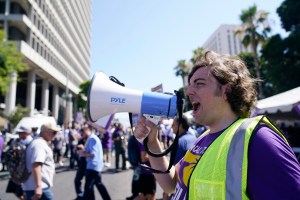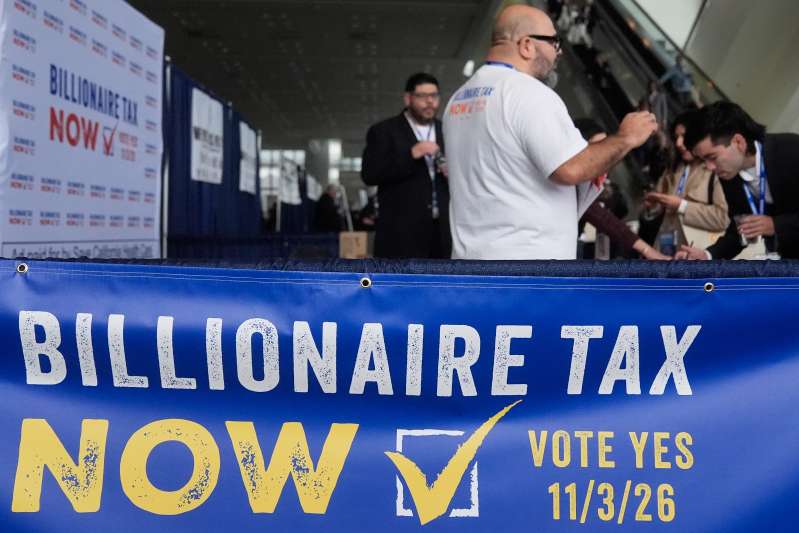
The California Billionaire Tax Act will officially be on the November Ballot, giving California voters the chance to enact a one-time tax on the state’s richest residents.
The labor union leading the measure, SEIU United Healthcare Workers West (SEIU-UHW), chose not to voluntarily withdraw its initiative at the request of Gov. Gavin Newsom before the Thursday deadline.
If passed, the proposal would impose a one-time 5% tax on any California resident with a net worth exceeding $1 billion. The measure was designed as a direct response to federal Medicaid funding cuts, which are projected to affect the state broadly, with up to 3.4 million California residents expected to lose Medi-Cal coverage. The revenue would go into a special fund allocated for state healthcare programs, such as Medi-Cal, and food assistance and public education. It is predicted to generate about $100 billion for the state if approved by voters.
The controversial proposal recently gained enough signatures to qualify for the November ballot, but has widely split the Democratic Party. Newsom has been amongst its most outspoken critics, and Xavier Becerra, the leading candidate to succeed Newsom as governor, also opposes the tax.
Newsom opposes state measure, wants national wealth tax instead
On Friday morning, Newsom published an op-ed and video on his Substack calling for a national wealth tax. He said he understood the rationale and anxiety driving the wealth tax proposal in the state.
“When 10% of the people in this country own two-thirds of the wealth, when we have minted the first trillionaire in human history, and yet your wages have stagnated, and your healthcare costs have skyrocketed, something is fundamentally broken,” Newsom wrote.
However, Newsom also reiterated his opposition to the measure, saying that it overlooks fundamental sections of the economy in need of funding.
“I’m voting no because this measure dedicates almost all of the revenue it raises to a single category of state spending,” Newsom wrote. “It ignores our public schools, as the California Teachers Association has rightly pointed out, by failing to provide sustainable funding that our communities, parents and children deserve. It turns a blind eye to safety-net clinics and reproductive healthcare providers that Planned Parenthood has fought for decades to protect.”
Instead of a state level tax, Newsom said he wants “a true minimum tax on billionaires,” to close tax loopholes and offshore loopholes utilized by the ultra-wealthy and corporations, to rewrite the nation’s inheritance tax laws, and to raise corporate tax rates.
The fight over the California billionaire tax continues
Currently, the ballot measure is backed by several notable unions, including SEIU-UHW, the Teamsters, and AFSCME California. Additionally, 54% of California voters say they would vote yes on the one-time tax, according to a May poll by the Public Policy Institute of California. Forty-five percent said they would vote no.
However, proponents of the bill have faced mounting opposition in recent months. The California Teachers Association, Planned Parenthood Affiliates of California and the California Medical Association have broken with labor allies and come out against the tax.
Supporters recently pivoted strategies in hopes of reaching a compromise with Democratic leadership. Earlier this month, the driving force behind the measure, the Billionaire Tax Now Coalition, wrote an open letter to Newsom proposing an alternative plan.
“In a spirit of unity to fix the problems created by the Trump cuts to the California healthcare system, we would like to join you in enacting a 2% version of our initiative instead of the original 5% version, provided you are prepared to stand with California families for this solution – and to lead on this policy issue for the good of the whole state,” the letter stated.
Newsom, however, rejected the scaled-back 2% offer.
Democratic opposition is only the tip of the iceberg; opposition campaigns have already raised $107.9 million as of June 15, according to reporting by CalMatters.
Many critics believe that taxing the wealthiest would drive businesses out of the state. Major tech billionaires and corporations have poured substantial funds into countermeasures and opposition groups. In anticipation of the measure, six of California’s roughly 200 billionaires allegedly left the state to avoid the proposed wealth tax.
Fortune Magazine reported that Google co-founders Larry Page and Sergey Brin, and venture capitalist Peter Thiel, relocated to Miami; car loan magnate Don Hankey moved to Las Vegas; and former Uber CEO Travis Kalanick announced he had moved to Texas.
Last year, billionaires residing in California paid a total of $4.1 billion in state income tax, or around 0.2% of their collective net worth of over $2 trillion, according to the National Bureau of Economic Research.
With negotiations no longer an option, the measure will now be certified for the November 2026 ballot, where it will face a well-funded opposition campaign and a divided electorate.