Few hiking destinations are as iconic as California’s Sierra Nevada. With sweeping views, friendly hikers, and an elevated escape into nature, the 211-mile John Muir Trail (JMT) attracts more than 1,500 thru-hikers annually.
Before it officially became the JMT, though, the Sierras and Yosemite inspired a man whose writing is still quoted over a century and a half later.
John Muir’s advocacy helped shape the conservation movement of the late 19th and early 20th centuries, influencing legislation that paved the way for national forests, national monuments, national parks, and, of course, the JMT.
Here’s everything you need to know.
John Muir Who?
John Muir was a Scottish American who is colloquially known as the “Father of the National Parks.” He wrote many essays, letters, and books about his time in the Sierra Nevada wilderness. Works such as “The Mountains of California” and “My First Summer in the Sierra” detail his time there, vividly describing the ecosystem and ultimately helping romanticize nature.
Mirroring some of the philosophy of Ralph Waldo Emerson in the earlier part of the 19th century, John Muir highlighted the importance of nature on the human condition. Some of his famous quotes include “the mountains are calling and I must go,” “in every walk with nature one receives far more than he seeks,” “climb the mountains and get their good tidings,” and “when we try to pick out anything by itself, we find it hitched to everything else.”
Co-founder of The Sierra Club, Muir used his writings and views to encourage protection of the natural world. The Sierra Club is one of the oldest and largest grassroots organizations in the United States. It largely focuses on conservation, environmental awareness, and climate change initiatives.
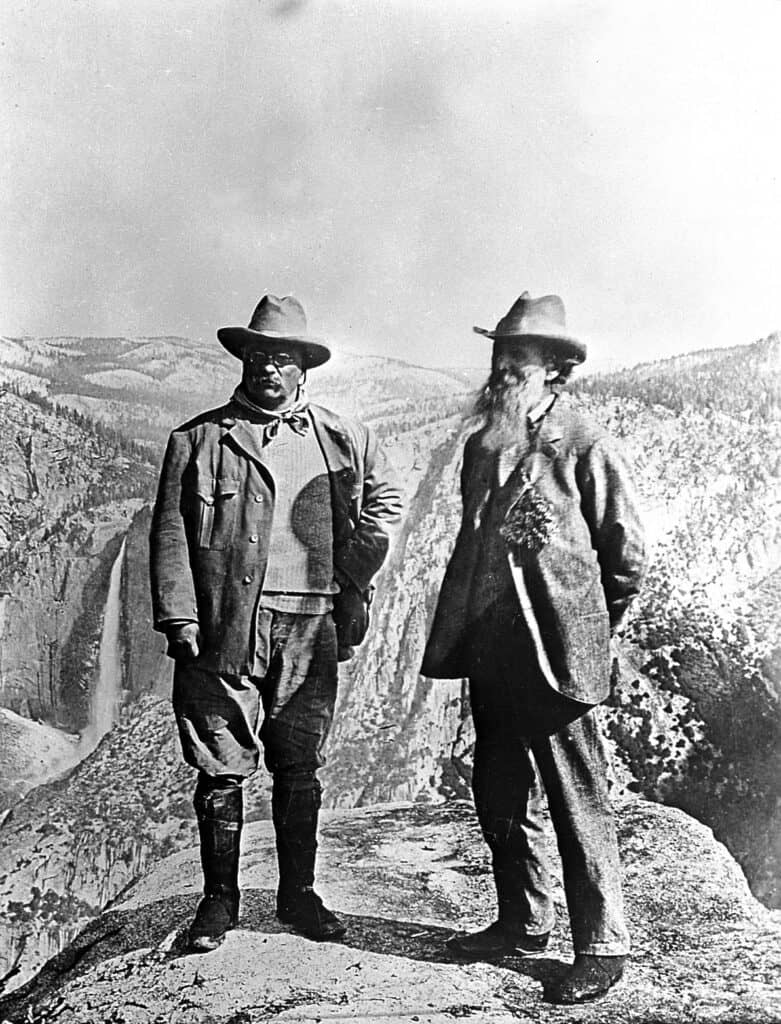
In 1903, John Muir took a camping trip with Theodore Roosevelt that would ultimately lead to the president becoming one of the nation’s foremost conservationists. Without his typical political entourage, Muir was able to convince Roosevelt of the importance of preserving nature. On this three-day excursion, Roosevelt witnessed firsthand the damage caused by logging and grazing. He said the experience was “like lying in a great solemn cathedral, far vaster and more beautiful than any built by the hand of man.”
After returning, Roosevelt’s policies quickly began to reflect the mission of the Sierra Club. In 1906, he signed the Yosemite Recession Act, which returned Yosemite Valley and Mariposa Grove to full federal control as part of Yosemite National Park. In the same year, he also signed the Antiquities Act, which empowered presidents to declare public landmarks and structures on federal lands as national monuments. Most notably, he enacted sweeping protections, ultimately safeguarding around 230 million acres of public land, including five national parks, 18 national monuments, and 150 national forests. His policies helped create federally protected pockets of nature.
Due to Muir’s impact on Roosevelt’s actions, he earned the “father of National Parks” moniker. Years after his 1914 death, the Sierra Club renamed its proposed California high-mountain route to memorialize the foundational role he played in establishing the National Park System as well as his passionate advocacy for preserving the Sierra Nevada wilderness.
If you decide to hike this trail, you will see the sweeping views, tall trees, and vast wilderness that inspired the legacy of this man’s life. Maybe you will even experience a whisper of the same passion.
What to expect
An experienced hiker may blaze the John Muir Trail in about 15 days, though this excursion takes the average hiker around three weeks to complete. Since there are steep gains and losses in elevation, most people choose to begin the journey going southbound (SOBO) for a more gradual adjustment. Beginning at Yosemite Valley offers a chance for acclimation since it places hikers at roughly 4,000 feet in elevation. Most hikers spend around two weeks climbing toward Mount Whitney, incrementally gaining elevation until reaching the peak of 14,505 feet! While the trail requires significant preparation, choosing SOBO is a great way to build stamina for the stark shift in elevations.
That said, SOBO is popular, and popularity comes with a drawback—permits are highly competitive. Those who wish to hike JMT must apply for a permit about 6 months in advance. Applicants must also be prepared for a 21-day rolling-window lottery that makes this permit so notoriously tricky to obtain. If your name is not drawn within that 21-day window, you must reapply. Going solo has a stronger chance of securing a permit, while group applications typically face lower odds of selection because there is a strict cap on daily hikers on the JMT.
The best time to hit the trail tends to be late July through mid-September. While snowpack dictates trail conditions each year, wildfire season also dictates air quality. The months most favorable for snow-free hiking also coincide with wildfire season. Choose your tradeoffs accordingly.
While the trail is 211 miles long, most hikers actually trek around 230 miles once resupply routes are factored in. Resupply stops are virtually impossible to avoid since carrying all the necessary gear plus three weeks of food would get bulky, heavy, and burdensome.
Popular resupply stops include Tuolumne Meadows, Reds Meadow Resort, Vermilion Valley Resort, and Muir Trail Ranch. While it is good to check for up-to-date requirements, these locations typically allow hikers to mail resupply boxes to themselves and pick them up. After all, this is a good time to stop for a night or two at a hotel, reconfigure the pack, and take in some much-needed bathtub soaks (maybe send some Epsom Salt to yourself?).
The area surrounding Donohue Pass contains a fragile ecosystem and serves as a bottleneck between Yosemite Valley and Inyo Forest. To avoid overcrowding, there is a strict limit of 45 daily JMT hikers allowed to exit over Donohue Pass. To qualify for exit through Donohue Pass, hikers must follow some basic rules and guidelines, including starting points.
There are only two eligible starting points that grant access to Donohue Pass. Happy Isles to Past Little Yosemite Valley is the first, and it is the official starting point for a complete southbound John Muir Trail thru-hike. It requires you to hike past the Little Yosemite Valley campground on your first night and has a daily cap of 15 hikers. The next is Lyell Canyon/Tuolumne Meadows. Bypassing the first 23 miles of JMT, it places hikers directly on the path with a gentler grade and has a cap of 30 daily hikers. It also allows hikers to get past the most aggressive permit competition. Again, choose your tradeoffs accordingly.
If you’re feeling run down just by the permit process, you are not alone. Many hikers jokingly say permits are the most difficult part of the JMT.
Be sure to make note of the various animals you may encounter on the trail, which include mule deer, marmots, Steller’s jays, Clark’s nutcrackers, pikas, coyotes, and black bears. On rarer occasions, you may even spot a Sierra Nevada bighorn sheep at higher, more rugged elevations, or perhaps catch a glimpse of an elusive bobcat or mountain lion. With bugs, plants, and so many wild things running around, it is best to be prepared for more than just the elements.
For example, this trail legally requires bear canisters for all food storage. There are also plenty of fresh water sources to drink from, but it’s rarely that simple. Be sure to bring a solid water filter and consider some sort of repellent for all the mosquitoes that are sure to be there. If you’re anything like me and struggle with directions, downloading an offline-capable FarOut Guide could come in very handy. And if you like to be prepared, reading through Halfway Anywhere’s JMT Survey could provide insight you didn’t know you needed. Always research and plan before any big hike.
Advice from an experienced thru-hiker
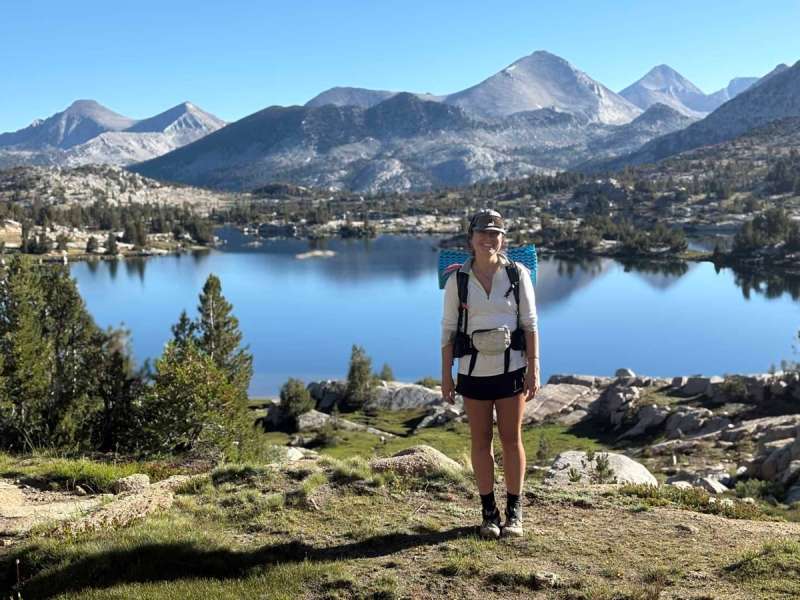
In 2019, a dear friend and I set off on separate adventures. While I took to solo traveling the country out of my car, she spent months researching and planning major thru-hikes. Marlene Hild’s efforts also served as a fundraiser for a scholarship in her late father’s name.
Her first major backpacking trip? The John Muir Trail. Since then, she has gone on to hike the Pacific Crest Trail, the Arizona Trail, and trails around the world, including routes in New Zealand and Portugal. Asked what she wished she had known before starting out, Hild shared some insight for those considering the JMT.
- Do your research on what to bring, what is recommended, and what you’ll actually need. Hild spent months collecting gear before her hike, laying everything out beforehand to decide what belonged in her pack, what should be mailed ahead to a resupply stop, and what could be left behind. From an outside perspective, her living room looked like a hiking store.
- Even if it’s in your own backyard, make sure you understand and have used every piece of gear you’re taking.
- If you’re hiking southbound, Hild recommends making time for Evolution Basin. “Evolution Basin is the first big, high-elevation granite basin you’ll see after a big climb from Evolution Valley and McClure Meadow. It blows away everything you’ve seen beforehand: beautiful lakes, towering white granite, and a great setup for sunset,” she says. Be aware that campsites are limited, so arriving early is recommended.
- Before beginning the JMT, take shorter hikes in the shoes you plan to wear. While most trail runners do not require a break-in period, testing them beforehand will help identify any potential hot spots or blisters that could otherwise end a hike early.
- There are plenty of people on the trail, so you can make friends and maintain a general sense of safety.
- Hild frequently downloads audiobooks or curates playlists ahead of time; she enjoys listening to both during her outdoor excursions. Fun fact: While hiking through New Zealand, she created a playlist for friends to collaborate on called “The Ring Must Be Destroyed.”
- These days, Hild spends much of her time backcountry hiking, where established trails are limited or nonexistent. “I’m experienced enough that hiking on a trail requires almost no thought for me. When there’s no trail, I have to think about every step.”
Whether the John Muir Trail is your first thru-hiking trip, your fiftieth, or simply a dream yet to unfold, here’s to all the great adventures ahead. As Muir wrote, “in every walk with nature one receives far more than he seeks.”
This article first appeared on Good Info News Wire and is republished here under a Creative Commons license.
Related: Where to head for the most scenic dispersed camping spots in California