Reporting by Jennifer Cortez, Palm Springs Desert Sun
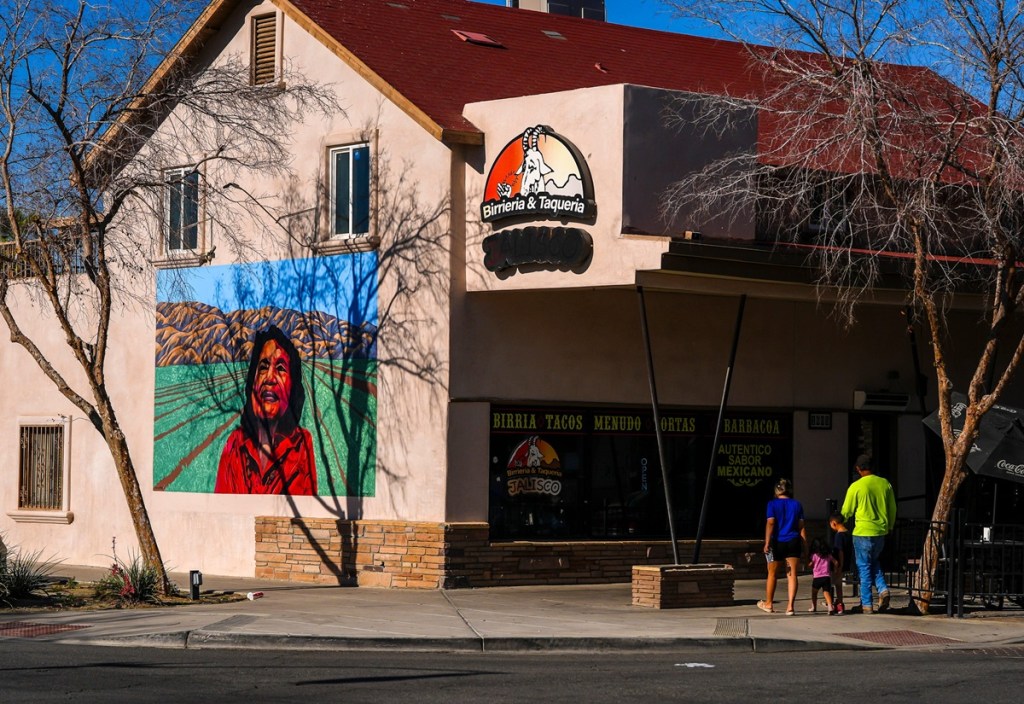
A mural depicting her portrait overlooks a street corner in downtown Coachella. An affordable housing community bears her name. More than three decades ago, a local health clinic was dedicated in her honor.
Dolores Huerta, the pioneering labor leader and civil rights activist who died Wednesday, Oct. 28, at 96, co-founded the organization that became the United Farm Workers and spent decades advocating for farmworkers across California.
From negotiating with grape growers in the 1960s to protesting pesticide use in the 1980s and drawing attention to farmworkers’ poor housing conditions in the 2000s, Huerta’s activism repeatedly brought her back to the Coachella Valley.
In a 2012 interview with The Desert Sun, shortly before receiving the Presidential Medal of Freedom, the highest civilian honor in the United States, Huerta said the eastern Coachella Valley’s agricultural fields “played a huge, huge role” in securing better wages and working conditions for California farmworkers.
She credited a 1965 strike by Filipino farmworkers in Coachella with inspiring labor actions across California. Huerta and César Chávez had founded their organization just three years earlier and believed it wasn’t ready for a strike. But the Filipino farmworkers’ courage spurred them to take action.
Five years later, in 1970, “the first table grape contract came out of the Coachella Valley with (local grower) Lionel Steinberg,” Huerta said in 2012. Steinberg stood apart from other growers in his willingness to negotiate with the union after years of boycotts.
As a result, Huerta called the valley “the gate that opened up the union contracts with the grape growers.”
Dolores Huerta’s activism across Coachella Valley
Over the decades that followed, Huerta continued returning to the Coachella Valley as farmworkers faced new battles over wages, pesticides and housing.
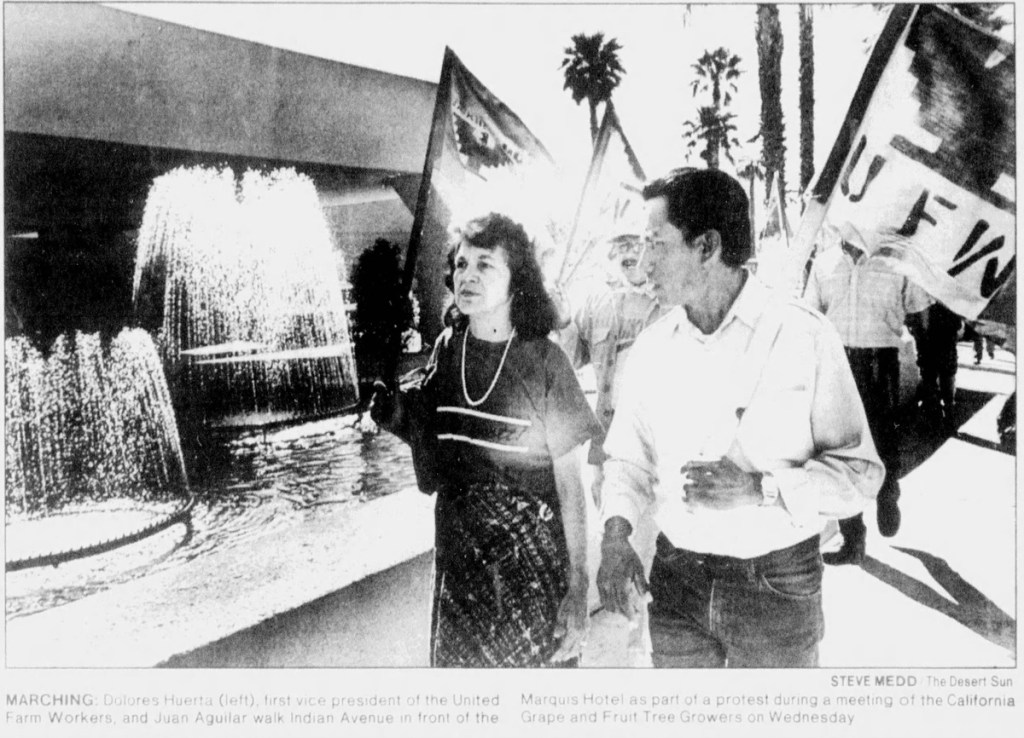
In 1989, she protested outside a hotel in Palm Springs where grape growers were meeting as the United Farm Workers pushed for new labor contracts and restrictions on pesticides it said endangered agricultural workers’ health. That year, she and Chávez also addressed about 900 people at Coachella Valley High School as the union continued its nationwide boycott of table grapes.
Huerta later joined a farmworker rally in 1994 where roughly 300 people in Mecca marched for higher wages, benefits and union contracts.
“We’re fighting for ourselves, our children, our future,” she told the crowd.
Huerta also championed immigrant workers’ rights at a 2003 rally in Palm Springs during the nationwide Immigrant Workers Freedom Ride. Hundreds attended, including students from Coachella Valley High School, many of whom had parents working in agriculture and hospitality.
A year later, she was arrested in Palm Springs while helping workers from two of Agua Caliente Band of Cahuilla Indians’ casinos protest for better pay. Although Huerta had been arrested at other protests, the arrest resulted in her first conviction.
“Six months probation,” she later recalled proudly.
In 2007, Huerta was the keynote speaker at a luncheon in Coachella where community leaders gathered to review a survey commissioned by Riverside County that found widespread poverty and unaffordable housing among local farmworkers.
“These conditions don’t have to exist,” Huerta said. “We are not a third-world country.”
Earlier this year, Huerta gained national attention again after she told The New York Times that Chávez, her partner in the workers’ rights movement, had raped her in 1966. The Times reported that it found wide evidence Chávez, who died in 1993, had “groomed” and sexually abused girls who worked in the movement.
How Coachella has honored Dolores Huerta
One of Coachella’s earliest documented tributes to Huerta came in 1993, when the now-defunct nonprofit El Progreso del Desierto dedicated its former health clinic on Sixth Street in her honor. More than 100 people attended the dedication and gave Huerta a standing ovation when she unveiled the clinic’s new sign.
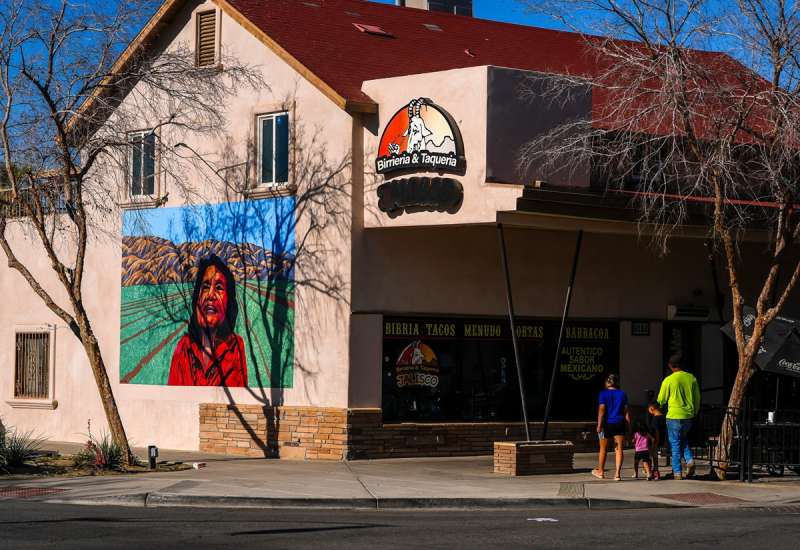
Nearly three decades later, in December 2021, Coachella unveiled “Legend, Dolores Huerta,” a mural by artist David Damian Figueroa on the exterior wall of Taquería & Birriería Guadalajara at Sixth Street and Vine Avenue. Huerta, then 91, attended the ceremony.
In a Facebook post celebrating the mural, Riverside County Supervisor V. Manuel Perez wrote, “It’s crazy to think how at one time in our history that Dolores Huerta, Cesar Chavez and the UFW were tear-gassed and ran out of the City of Coachella and the County of Riverside.”
“I remember in that park right behind us when we were running away from the police, they were chasing us with tear gas,” Huerta said at the ceremony. “We were having a rally, nobody was doing anything wrong, and all of a sudden they came at us with batons, hitting people, and we’re all running for our lives.”
Although she is smiling in the mural, Huerta described the years of strikes and boycotts as “a time of anxiety, a time of suffering,” Patch reported at the time.
Huerta returned to Coachella in April 2022 for the groundbreaking of Placita Dolores Huerta, an affordable housing development off Bagdad Avenue. The first phase opened in May 2024 with 56 apartments housing about 200 residents, many of them agricultural workers.
“Now, we know that Coachella is famous all over the United States and the world because of Coachella festival,” Huerta had said. “But we should not let people forget, and the true reason Coachella needs to be remembered is for the sacrifices that people made to bring justice to the farmworkers that feed the nation. That is what (Coachella) needs to be known for, and I’m just blessed that I was a part of it.”
Jennifer Cortez covers education and breaking news in the Coachella Valley. Reach her at jennifer.cortez@desertsun.com.
This article originally appeared on Palm Springs Desert Sun.
Related: California among 20 states suing Dollar General. Why are they suing?